
The First Step for Free Movement
If you're a highly sensitive former dancer, you've probably become very good at getting things done.
Pick this up. Walk over there. Finish the task. Push through.
But what if getting something done isn’t actually the first step?
In this video, we'll explore one of the central ideas behind the Alexander Technique: the quality of your attention influences the quality of your movement.
Before we act, we can pause. We can come back to the body as it is right now instead of acting from a scattered, overwhelmed, or disconnected state. We'll explore how pausing can help you feel more grounded, more embodied, and more at ease in your everyday life. If movement has begun to feel heavy, awkward, or difficult, this simple practice may help you rediscover a more ease.
If you’d like to go deeper, I offer free consultations in which we can discuss what you need and how to apply this work to your body and your movement.
A transcript of the video is below if you’d prefer to read rather than watch and listen.
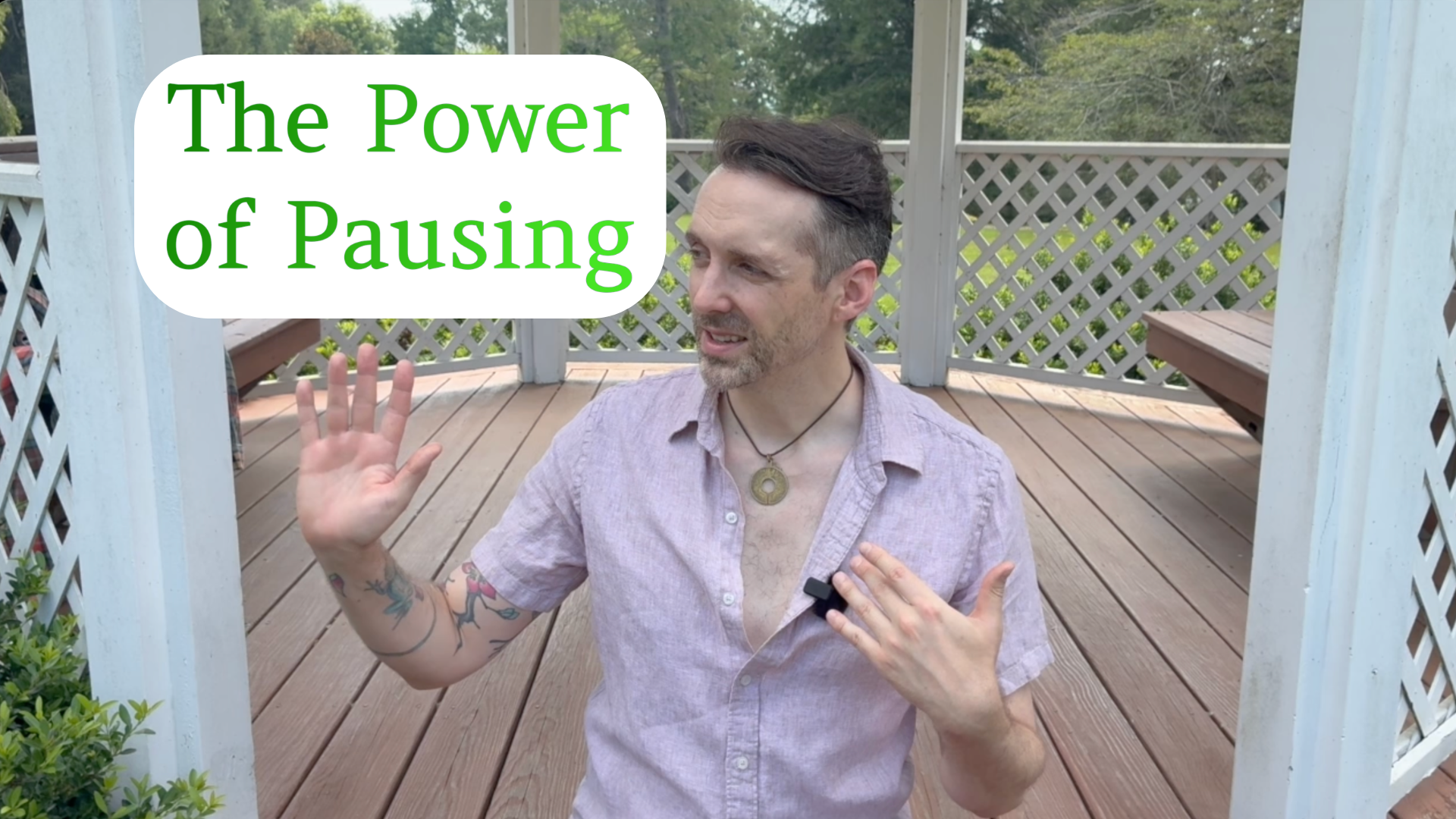
Hello, friend.
Are you skipping the first step? For a lot of us, the first step seems like the thing. Pick this up. Walk over there. Get this done. Put this down. Lift your arms. Kick your leg. That seems like the first step.
But if your mind is scattered or tense or stressed or feeling jumbled, your movement, your body will reflect those states and that informs what's happening, how you do things.
So, the first step is not getting it done. Getting the action done, getting the movement done, getting the activity done, getting your work done. There’re a few steps before that that can influence the way you get things done.
So, what's the first step? The first step is to pause.
And pausing is not freezing.
It's not stiff. It's more like saying just a moment. I need a moment. and then coming back to your body as it is right now and what it is right now in a very fundamental way. So, pause wherever you are right now. Take a moment.
You have a head. You're welcome to touch it. It's something that is.
You have breath and ribs. You're welcome to touch them. They are already there.
You're sitting or standing or lying down. It's one of those.
Now, from this place, from an embodied place, then you pick up the book. You walk. You type. You raise your arms.
So many of us, especially for highly sensitive people, we're often influenced by the environment quite easily and quickly and influenced by our own internal environment.
We're dealing with those influences and also trying to get so much done.
And we're doing it from that jumbled place, from that scattered place, from that place of feeling what's happening around us.
So, pause just a moment.
When we're influenced in that way, scattered that way, we are somewhat disembodied. We're not present with just the body as it is now. We might be present with a body as it was 20 years ago or one that we think will be like in 10 years. Or we might just be present with our idea of our body, which might not really be that accurate.
So, pause a moment.
This body, this head, these ears, these hands, these elbows, these shoulders. They're there. They are already there. You don't even have to make them be there. They are what is. Come back to this body and then proceed.
So, are you skipping the first step? The first step is to be embodied. See what it's like as you go through your day today. Pause. Come back to this body. What is it? And then continue?
Let that be your real first step. And notice how whatever it is you're doing gets easier, more enjoyable to do.
It's nicer to do things when you're in this body than when you're somewhere out there.
Play around with it. Let me know what you discover. And as always, if you need any help, that's why I'm here. Till we meet again, take care.